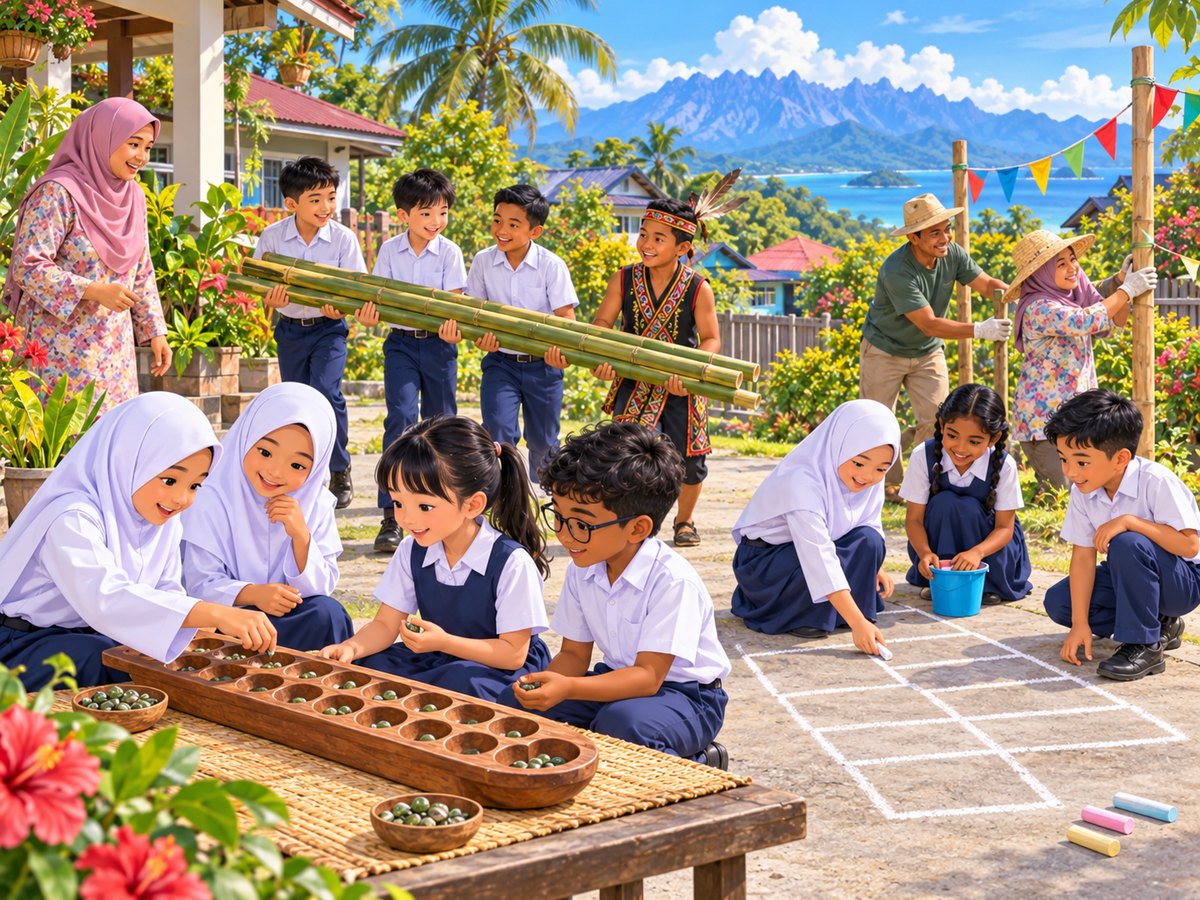
Tugas menjadi ringan apabila setiap orang memainkan peranan.
Situasi baharu
Laman Permainan Bersama
Penduduk bekerjasama menyediakan ruang permainan tradisional.
Pasukan MelurSusun congkak
Pasukan KenangaLukis teng-teng
SemuaKemas laman
Pembahagian tugas yang jelas membantu kumpulan mencapai matlamat bersama.
kerjasama = 合作;eratkan hubungan = 拉近关系。真正的合作包含共同目标、清楚分工和互相尊重,不是把所有工作交给同一个人。每个人完成自己的职责,也要留意伙伴是否需要支援。例子:一组摆放 congkak,另一组画跳格子,最后大家一起清理场地。注意:分工不代表各做各的,完成后仍要互相检查成果。
kerjasama = cooperation; eratkan hubungan = strengthen relationships. Real cooperation needs a shared goal, clear roles and mutual respect rather than leaving every task to one person. Each member completes a responsibility and remains ready to support others. Example: one team arranges congkak boards, another paints a hopscotch grid, and everyone checks the area together. Watch out: dividing work does not mean ignoring the other teams.
1.1.2 · Mendengar dan Bertutur
Dengar dan berikan respons
Fahami arahan sebelum menjawab dengan alasan yang sesuai.
Taklimat penyelaras
Semua peserta berkumpul di laman pada pukul 7:30 pagi. Pasukan Melur akan menyusun papan congkak, manakala Pasukan Kenanga akan melukis petak teng-teng. Tugasan dibahagikan supaya kedua-dua kerja dapat dijalankan serentak. Selepas itu, semua peserta mengemas kawasan bersama-sama.
Respons lengkap: Saya bersetuju dengan pembahagian itu kerana kerja dapat disiapkan secara teratur.
memberikan respons = 作出回应。聆听后要先理解说话者的安排或理由,再针对问题回答;完整回应通常包含立场和依据。若题目问“为什么”,答案需要使用 kerana 或 supaya 说明原因或目的。例子:听到两组同时工作,可回应“安排很合适,因为能够节省时间”。注意:只重复任务名称,还没有真正回应问题。
memberikan respons = give a response. First understand the speaker's arrangement or reason, then answer the exact question. A complete response often includes a position and supporting evidence. When asked why, use kerana or supaya to explain a reason or purpose. Example: after hearing that two teams work at the same time, respond that the plan is suitable because it saves time. Watch out: merely repeating the task names does not answer the question.
Semak segera · Mendengar
Mengapakah tugasan dibahagikan?
Pilih respons yang menjawab sebab dengan tepat.
Mengapakah tugasan Pasukan Melur dan Pasukan Kenanga dibahagikan?
mengapakah = why. Listen for a connector that introduces a purpose or reason, then check whether a choice preserves the speaker's intention. The response must explain the division of work, not the meeting time or a later clean-up task. Example: if two groups are formed to plant and water at the same time, the answer must express simultaneous work. Watch out: mentioning the correct participants does not automatically explain the reason.
2.1.1 · Membaca
Daripada tersurat kepada tersirat
Gabungkan petunjuk dalam teks untuk memahami maksud yang tidak ditulis terus.
Teduhan untuk Semua
Beberapa orang belia memegang rangka buluh supaya tidak bergoyang. Pada masa yang sama, orang dewasa mengikat kain teduhan pada rangka itu. Walaupun hujan renyai turun seketika, mereka menyiapkan tempat berteduh sebelum tengah hari. Selepas bekerja, semua penduduk dapat berehat bersama-sama di bawah teduhan baharu.
Tersurat: Dua kumpulan melakukan tugas yang saling melengkapi. Tersirat: Kerjasama menjadikan kerja lebih cepat dan selamat.
maklumat tersirat = 隐含信息。文章不会直接写出答案,读者要把两个或更多明示线索连起来,再作出有证据的推断。先列出发生的动作和结果,然后问这些线索共同说明什么。例子:有人扶梯子,另一个人挂横幅,横幅很快完成,可推断合作使工作更顺利。注意:推断必须能够回到文章找到依据,不可凭空想象。
maklumat tersirat = implicit information. The answer is not stated directly, so combine two or more explicit clues and make an evidence-based inference. List the actions and their result, then ask what those clues show together. Example: one person steadies a ladder, another hangs a banner, and the banner is finished quickly; this supports the idea that cooperation makes work smoother. Watch out: an inference must be traceable to the passage rather than invented.
Semak segera · Membaca
Apakah maklumat tersirat daripada petikan?
Gabungkan tindakan penduduk dengan hasil kerja mereka.
Apakah yang dapat disimpulkan daripada pembinaan tempat teduhan itu?
disimpulkan = inferred or concluded. Choose a statement that explains the passage's actions and result together, not one that merely repeats a single detail. Test the reasoning with 'Because the text says ..., I can infer ...'. Example: residents take turns carrying books and the reading corner opens on time, so shared work improved efficiency. Watch out: absolute words such as all, only and must need very strong evidence.
3.2.1 · Menulis
Nyatakan pendapat dengan alasan
Gunakan bahan sebagai bukti untuk membina ayat yang lengkap.
CadanganPeserta bertukar stesen
SebabSemua mencuba permainan
KesanLebih saling mengenali
Pada pendapat saya, peserta wajar bertukar stesen kerana semua orang dapat mencuba permainan dan berkenalan.
menyatakan pendapat = 表达意见。完整的意见句包含观点、理由,有时再加结果;可以用“Pada pendapat saya”开头,以 kerana 连接依据。材料里的时间、安排或目标应成为理由,而不是被原样抄成无关句子。例子:我赞成轮流使用器材,因为每组都有公平机会。注意:只写“Saya setuju”没有说明为什么,内容还不完整。
menyatakan pendapat = state an opinion. A complete opinion sentence gives a position, a reason and sometimes an effect. It may begin with Pada pendapat saya and connect evidence with kerana. Use a detail from the material as support instead of copying an unrelated line. Example: I agree that groups should take turns because everyone receives a fair chance to use the equipment. Watch out: Saya setuju alone gives no reason and is incomplete.
Semak segera · Menulis
Ayat pendapat manakah paling lengkap?
Cari pendapat yang disokong oleh alasan daripada bahan.
Pilih ayat pendapat yang lengkap tentang pertukaran stesen.
ayat pendapat lengkap = 完整的意见句。先找说话者的立场,再找是否有 kerana 引出的具体理由;理由必须与题目材料有关。只有事实陈述不是意见,只有“有趣、很好”却没有依据也不够充分。例子:“我赞成分组,因为场地可以保持整齐”同时包含立场和理由。注意:句子较长不代表一定完整,关键是逻辑结构。
ayat pendapat lengkap = a complete opinion sentence. Find the writer's position and then a specific reason, often introduced by kerana, that relates to the material. A factual statement is not an opinion, while a vague word such as interesting gives weak support. Example: 'I support grouping because the area can remain orderly' contains both a position and a reason. Watch out: length alone does not make an opinion complete; its reasoning does.
4.2.1 · Seni Bahasa
Lafaz syair, fahami idea
Perhatikan sebutan, irama dan maksud keseluruhan rangkap.
Syair Laman Harmoni
Pagi cerah di laman harmoni, Jiran berkumpul seikhlas hati, Tugas dibahagi tekun sekali, Laman ceria hasil bersinergi.
Anak bermain ketawa berseri, Orang dewasa saling menghargai, Kerja sepakat mengikat diri, Hubungan erat kekal abadi.
syair = 诗歌;idea keseluruhan = 整体主旨。朗诵时要读准词语、保持稳定节奏,并通过各行重复出现的行动和结果理解整首诗。主旨不是某一行的细节,而是所有诗节共同传达的信息。例子:多行写分工、尊重和关系长久,整体就围绕合作带来的团结。注意:不要因为诗中出现“孩子玩耍”,便把主旨只缩成游戏。
syair = a traditional Malay poem; idea keseluruhan = overall idea. Recite with accurate pronunciation and steady rhythm, then notice the actions and results repeated across the lines. The overall idea is broader than one detail from one line. Example: when several lines mention shared duties, respect and lasting bonds, the poem centres on cooperation building unity. Watch out: the appearance of children playing does not make play the whole poem's message.
Semak segera · Seni Bahasa
Apakah idea keseluruhan Syair Laman Harmoni?
Pilih idea yang merangkumi kedua-dua rangkap.
idea keseluruhan = 整体主旨。把每节诗各用几个关键词概括,再找共同部分;能够同时覆盖行动和结果的选项通常更完整。主旨应解释为什么诗人写分工、欢乐与关系长久。例子:若两节分别写种树和共享树荫,共同主旨可能是共同劳动造福大家。注意:只覆盖第一节或一个人物的选项太狭窄。
idea keseluruhan = overall idea. Summarise each stanza with a few keywords, then find what both stanzas share. A strong overall idea covers the action and its result and explains why the poem mentions shared duties, joy and lasting bonds. Example: if one stanza describes planting trees and another enjoying their shade, the shared idea may be joint effort benefiting everyone. Watch out: a choice covering only the first stanza is too narrow.
5.1.1(ii) · Tatabahasa
Kata nama khas
Nama khusus bagi manusia, haiwan, tempat, program atau benda.
Puan Salinamanusia
Si Belanghaiwan
Taman Murnitempat
Program Laman Ceria dikendalikan oleh Puan Salina di Taman Murni.
kata nama khas = 专有名词。它指特定的人、动物、地点、计划或物品,主要词通常以大写字母开头。与普通名词比较:taman 是一般公园,Taman Murni 是特定地点;puan 是称呼,Puan Salina 指特定人物。例子:Si Comel 可以是某只宠物的名字。注意:句中出现大写必须有理由,不可把所有重要词都写成大写。
kata nama khas = proper noun. It identifies a particular person, animal, place, programme or object, and its main words normally begin with capital letters. Compare taman, a general park, with Taman Murni, a specific place; compare puan with Puan Salina. Example: Si Comel can be the name of one particular pet. Watch out: capital letters need a naming reason, so not every important word should receive one.
Tatabahasa · Kata nama khas 1
Yang manakah kata nama khas bagi manusia?
Bezakan gelaran umum daripada nama individu.
nama khusus manusia = 特定人物名称。判断时问这个词组是否能明确指出某一个人;职业、身份或一群人的一般称呼并不属于专名。称呼和人名结合时,两部分通常都大写。例子:doktor 是一般职业,Doktor Farid 指特定医生。注意:复数人物词通常表示类别,不会自动成为专名。
nama khusus manusia = a particular person's name. Ask whether the phrase identifies one individual; a job, role or general group does not. When a title is joined to a person's name, both parts normally begin with capitals. Example: doktor is a general occupation, while Doktor Farid identifies one doctor. Watch out: a plural word for people usually names a category and does not automatically become a proper noun.
Tatabahasa · Kata nama khas 2
Pilih ayat dengan huruf besar yang betul.
Semak nama program dan tempat.
Ayat manakah menulis kata nama khas dengan betul?
huruf besar kata nama khas = 专名大写。计划名称和地点名称的主要词都应使用大写,但句中的普通动词和介词保持小写。先分别框出“活动叫什么”和“地点叫什么”,再检查每个主要词。例子:“Hari Sukan Komuniti berlangsung di Dewan Bestari.”有两个完整专名。注意:只把专名最后一个词大写仍然不完整。
huruf besar kata nama khas = capitals in proper nouns. The main words in a programme name and a place name should begin with capitals, while ordinary verbs and prepositions remain lowercase. Identify the activity name and location name separately before checking each important word. Example: 'Hari Sukan Komuniti berlangsung di Dewan Bestari' contains two complete proper names. Watch out: capitalising only the last word of a multiword proper name is incomplete.
5.1.1(iii) · Tatabahasa
Kata ganti nama
Gunakan kata ganti diri, tanya dan tunjuk mengikut fungsi.
kami · kita · merekadiri
siapa · apa · manatanya
ini · itu · sinitunjuk
Aina: Siapakah yang membawa congkak ini?
Ravi: Kami membawanya. Mari kita susun di sini.
kata ganti nama = 代词。人称代词替代人物名称,疑问代词用来提问,指示代词指出物品或位置;选择时要看句子功能。kami 不包括听者,kita 包括说话者和听者,mereka 指第三方多人。例子:老师对全班说“Kita mulakan sekarang”包含老师和学生。注意:不要只凭熟悉程度选择,要先判断谁被包括在内。
kata ganti nama = pronoun. Personal pronouns replace names, interrogative pronouns ask questions, and demonstrative pronouns point to an object or location. Kami excludes the listener, kita includes both speaker and listener, and mereka refers to other people. Example: when a teacher tells the class 'Kita mulakan sekarang,' both teacher and pupils are included. Watch out: choose by the sentence's function and participants, not by which word looks most familiar.
Tatabahasa · Kata ganti nama 1
Pilih kata ganti diri yang sesuai.
Penutur mengajak semua ahli termasuk dirinya.
___ akan mengemas laman ini bersama-sama, kata ketua kepada semua ahli.
kata ganti diri = 人称代词。先找说话者、听者和所指的人,再判断句子包括哪些人。若说话者邀请面前的所有成员一起行动,需要一个同时包含“我”和“你们”的代词。例子:朋友对你说“Kita belajar bersama”表示朋友和你一起学习。注意:kami 包括说话者的一方,却把正在听的人排除在外。
kata ganti diri = personal pronoun. Identify the speaker, listener and other people before deciding who is included. When a speaker invites all members in front of them to act together, the pronoun must include both 'we' and 'you'. Example: a friend saying 'Kita belajar bersama' includes the friend and you. Watch out: kami includes the speaker's group but excludes the person being addressed.
Tatabahasa · Kata ganti nama 2
Pilih ayat tanya dan tunjuk yang tepat.
Perhatikan fungsi kata untuk bertanya dan menunjuk.
Ayat manakah menggunakan kata ganti nama tanya dan tunjuk dengan tepat?
kata ganti tanya dan tunjuk = 疑问代词与指示代词。疑问代词要放在能清楚询问人物、物品或选择的位置;指示代词则指出靠近或较远的对象。检查句子是否自然、问题对象是否明确。例子:“Apakah yang terdapat di dalam kotak itu?”用 apa 提问,用 itu 指向盒子。注意:把疑问词随意放在句末会令结构和意思混乱。
kata ganti tanya dan tunjuk = interrogative and demonstrative pronouns. An interrogative pronoun must clearly ask about a person, thing or choice, while a demonstrative pronoun points to a near or more distant object. Check that the sentence sounds natural and the unknown item is clear. Example: 'Apakah yang terdapat di dalam kotak itu?' uses apa to ask and itu to point. Watch out: placing a question word randomly at the end can distort the sentence.
Ringkasan Unit 2
Bahasa membantu kita bekerjasama
Dengar, fahami, beri alasan dan pilih kata yang tepat.
ringkasan = summary. Cooperation depends on listening to arrangements, making evidence-based inferences, giving supported opinions and choosing precise language. A poem can express the value of unity, while proper nouns and pronouns clarify people, places and objects. Example: after hearing the roles, say that the group agrees because everyone has a task. Watch out: relationships grow through shared participation and respect, not through a slogan alone.
Unit 2 selesai
Syabas!
Teruskan dengan lapan soalan pengukuhan.
Kerjasama yang baik bermula dengan komunikasi yang jelas.